

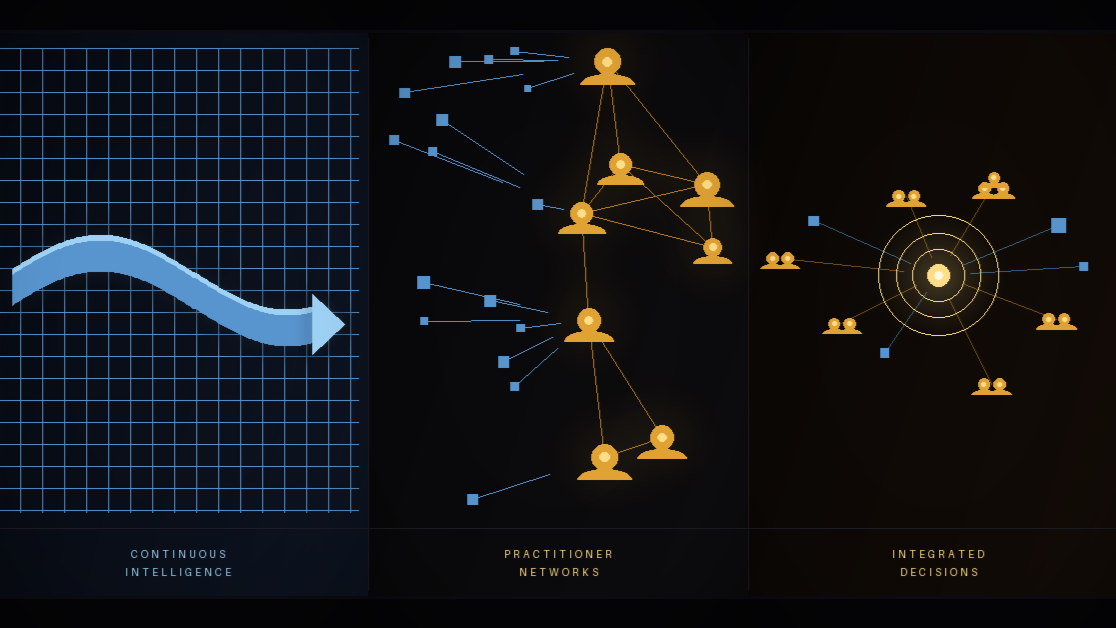
For COOs and strategy executives at complex industrial and technology companies, strategic intelligence has become one of the most pressing operational challenges of the current moment. Simultaneous disruptions — tariff volatility, supply chain reconfiguration, AI-driven competitive shifts, and regulatory divergence between the US and Europe — are moving faster than traditional review cycles were designed to track. Meeting this challenge requires more than accelerating existing processes. It requires three transitions: from periodic reviews to continuous intelligence, from data extraction to purpose-built practitioner networks, and from sequential analysis to integrated decision-making. Together, these define what effective strategic intelligence infrastructure now demands.
From periodic reviews to continuous intelligence
The periodic review processes most organizations rely on — annual strategy cycles, quarterly business updates, competitive deep-dives — were designed for an environment in which material disruptions arrived with enough lead time to be incorporated before decisions needed to be made. In the current environment, that assumption no longer holds. Trade policy can shift in weeks. Competitive dynamics from AI deployment move within product cycles. A strategic assessment completed in one quarter can be structurally obsolete by the next.
Effective intelligence in this environment needs to operate as a continuous organizational function rather than a periodic one. Continuously updated dashboards, real-time market monitoring, and AI-powered synthesis of available information are valuable tools in this direction — each reducing the lag between what is happening and what the organization knows. The goal they point toward is an organization that maintains a live read of its relevant environment at all times: one for which intelligence is not a scheduled activity but an ongoing capability, feeding decisions as they arise rather than preparing for decisions that are already scheduled.
From data extraction to practitioner networks
Continuous intelligence, however, requires more than increased frequency or more powerful tools to process available data. The most consequential intelligence in fast-moving conditions does not exist in data sources — it exists in the knowledge of people who are themselves active participants in the environments an organization is trying to understand.
For example, regulatory specialists advising on trade policy in a relevant jurisdiction know where policy is moving before it moves — not because they have analyzed more data, but because they are part of the conversations in which those directions are being shaped. Supply chain operators in a specific geography understand its actual constraints in ways no published source reflects, because those constraints are the texture of their daily work. Market participants embedded in relevant industry networks know what competitors, customers, and authorities are deciding before those decisions become externally visible, because they are close to where those decisions are made. What makes this intelligence current is not how recently it has been gathered. It is that the people holding it are continuously engaged in the relevant environment.
Accessing this category of intelligence requires purpose-built practitioner networks — communities of active specialists, organized around the specific strategic questions and geographies that matter, and maintained as standing relationships rather than episodic project engagements. These are the networks through which intelligence that anticipates events, rather than merely recording them, becomes accessible to an organization’s decision-makers.
From sequential analysis to integrated decision-making
Continuous access to practitioner intelligence delivers its full value only when it is integrated directly into the decision process — not as a separate function that periodically reports to a decision-making body, but as a continuous input to decisions as they are being made.
Building this integration starts with a precise mapping of the practitioner communities relevant to a given set of strategic questions: which regulatory environments, supply chain networks, competitive sectors, and geographic markets are the actual decision-making contexts for the issues at hand. It requires structures that allow practitioner intelligence to reach decision-makers in real time — so that when the environment shifts, the shift is visible immediately rather than at the next scheduled review. And it requires a decision process designed to act on continuously updated intelligence, rather than one structured around periodic input.
The organizations that have built this model operate with a materially different quality of strategic situational awareness. They are not better at analyzing what has happened. They are better connected to what is happening — and to what the people closest to relevant decisions are currently thinking and doing. In an environment where the interval between an intelligence read and a consequential decision can no longer be measured in months, that connection is the structural advantage that other improvements to the analytical process cannot replicate.
Get in touch with us and we will get back to you immediately.

.png)
10EQS needs the contact information you provide to us to contact you about our products and services. You may unsubscribe from these communications at any time. For information on how to unsubscribe, as well as our privacy practices and commitment to protecting your privacy, please review our Privacy Policy.

%2C%20Color%3DNegative.svg)

